
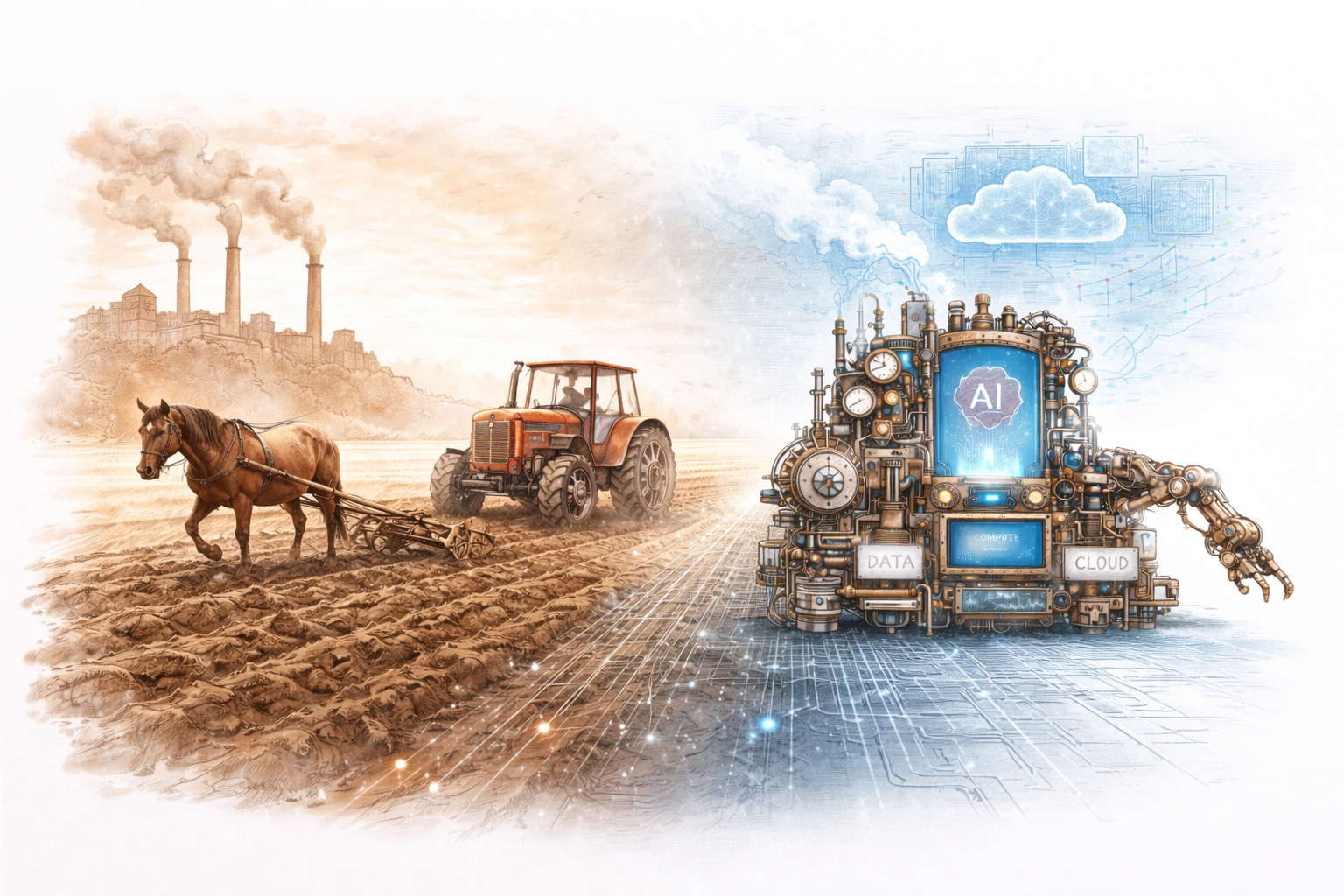
For the past few years, comparisons between artificial intelligence and the Industrial Revolution have become almost unavoidable.
Executives, investors, and technologists alike reach for familiar metaphors: the tractor replacing the horse, machines replacing manual labor, a step-change in productivity.
At a glance, the analogy feels right.
| Industrial Revolution | AI Revolution |
|---|---|
| Replaces tools | Amplifies systems |
| Substitution | Amplification |
| Reduces dependency on prior systems | Intensifies dependency on foundations |
I originally adopted this notion, but when you look closely, it breaks in an important and dangerous way.
The Industrial Revolution replaced tools. The AI revolution amplifies systems.
That distinction matters more than most people realize.
The Tractor and the Horse
The Industrial Revolution fundamentally reshaped agriculture, manufacturing, and society by substituting old tools with new ones.
When tractors replaced horses:
- Animal labor disappeared
- Human labor shifted or vanished
- Productivity increased through replacement
- The old system became obsolete
By the early 20th century, mechanized farming collapsed centuries-old agricultural models. In 1900, nearly a quarter of the U.S. workforce was employed in agriculture. By mid-century, that number had dropped below 10%, largely due to mechanization.
This was a one-for-one trade:
| Old System | New System |
|---|---|
| Horse | Tractor |
| Ox-drawn plough | Mechanized plough |
| Manual labor | Industrial machinery |
Once adopted, there was no reason to maintain the old foundation.
“The machine does not isolate man from the great problems of nature, but plunges him more deeply into them.” — Henry Ford
Machines didn’t eliminate complexity, they relocated it into the mechanical system itself. And crucially, once that system existed, it stood on its own.
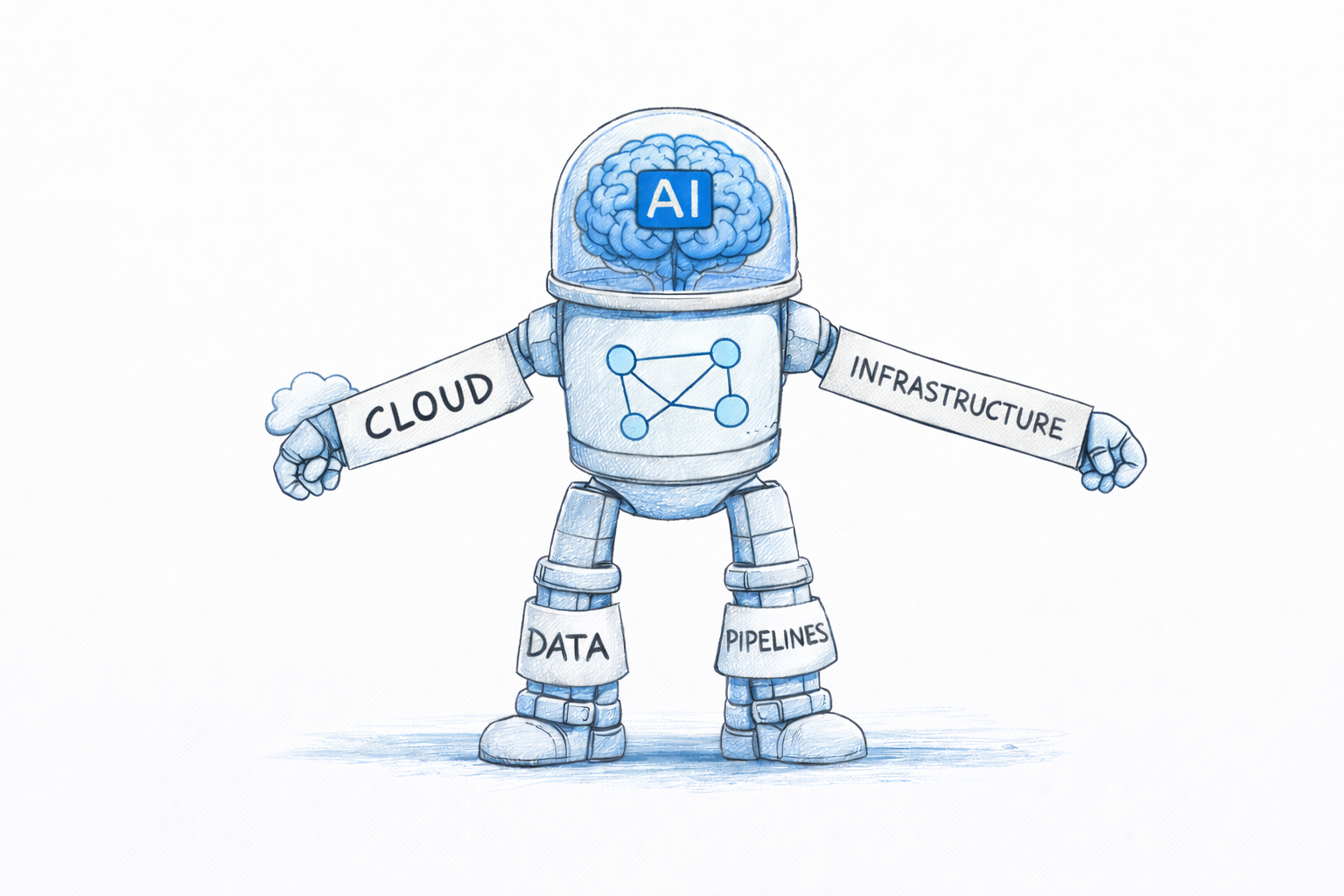 Caption: AI is a cog in a cohesive system.
Why the Analogy Breaks With AI
This is where the comparison starts to fail. Generative AI does not replace the systems beneath it. It consumes them. AI is not a tractor. It is not a tool that swaps cleanly with an old one. AI is an amplifier.
Every meaningful AI capability today depends on:
- Large-scale distributed systems
- Elastic, reliable cloud infrastructure
- Sophisticated data engineering pipelines
- Clean, governed, well-labeled data
- Operational excellence in reliability, security, and cost control
Remove those foundations, and AI doesn’t merely slow down, it stops working.
This is a structural inversion from the Industrial Revolution. Where industrialization reduced dependency on prior systems, AI intensifies dependency on its foundations.
Substitution vs Amplification
The Industrial Revolution was built on substitution. The AI revolution is built on amplification.
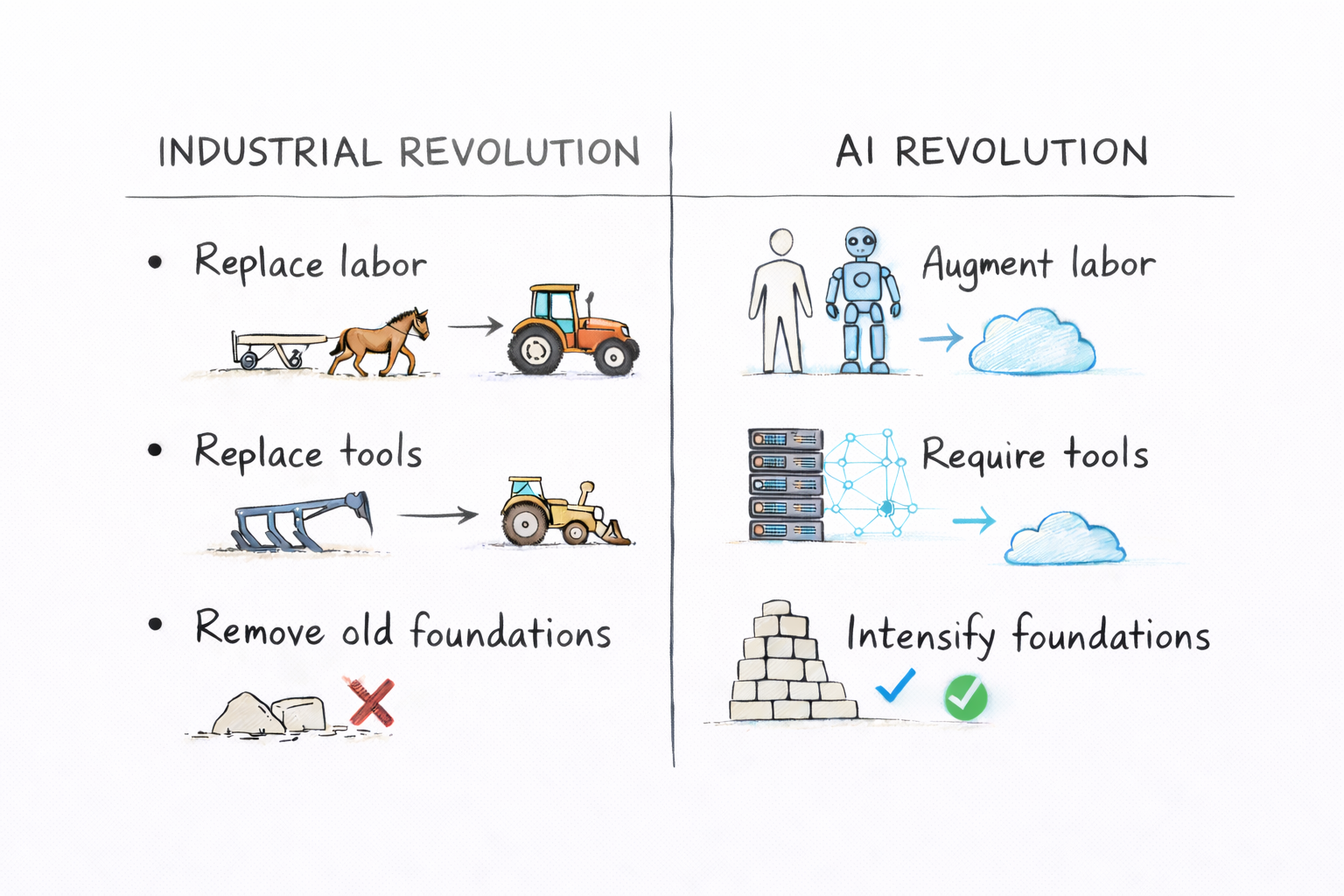 Caption: The Industrial Revolution replaced tools. The AI revolution amplifies systems.
This is why the framing matters.
AI does not replace cloud computing.
AI does not replace data engineering.
AI does not replace distributed systems.
AI requires them, at a scale and rigor most organizations are not prepared for.
The Dangerous Trade-Off
Here’s a risk that shows up quickly in boardrooms and investor conversations: treating AI as a reason to reduce cloud, platform, and data investment.
This is the modern equivalent of selling the power plant to buy electric appliances.
Large language models require:
- Massive distributed compute for training
- Low-latency, highly available platforms for inference
- Strong data governance to avoid compounding errors
- Secure, observable systems to operate responsibly at scale
If organizations trade foundational investment for AI experimentation, the result is not acceleration, it is fragility.
During the Industrial Revolution, abandoning horses made sense. During the AI revolution, abandoning foundations guarantees failure.
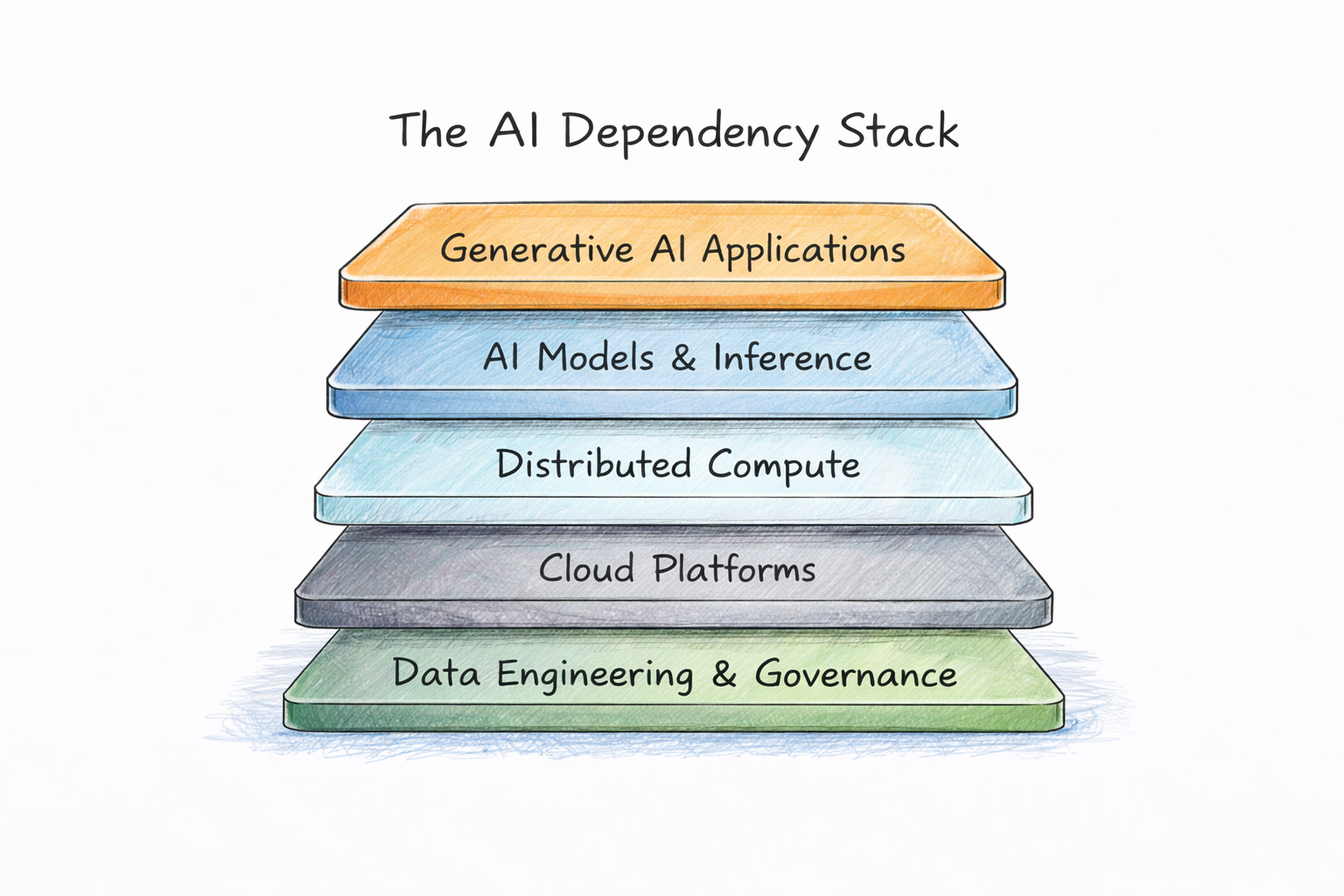 Caption: AI sits at the top of a very tall stack.
First-Wave and Second-Wave Winners
This difference creates a clear separation between short-term success and long-term advantage.
First-Wave AI Winners
Early leaders in AI adoption tend to be organizations that already invested heavily in:
- Cloud platforms
- Distributed systems
- Data engineering and analytics
- Operational discipline
They move quickly not because AI is easy, but because the foundation already exists.
Second-Wave AI Winners
The enduring winners will be those who:
- Continue investing in foundations after early AI wins
- Resist the urge to “optimize away” cloud and data teams
- Treat AI as a force multiplier, not a shortcut
- Understand that reliability, scale, and data quality compound over time
“The best means of benefiting the community is to place within its reach the ladders upon which the aspiring can rise.” — Andrew Carnegie
In the AI era, infrastructure and data are those ladders.
The Real Lesson of History
The Industrial Revolution automated muscle. The AI revolution amplifies cognition, but only if the nervous system exists.
History doesn’t show us that revolutions fail because technology moves too fast. It shows us they fail when leaders misunderstand what must remain while everything else changes.
AI is not a replacement for the cloud era. It is built on top of it, just as the cloud era was not a replacement for hardware.
The organizations that win the first wave of AI will be those with strong foundations. The organizations that endure into the second wave will be those disciplined enough to keep investing in those foundations when it’s no longer fashionable.